Chinese New Year marks the start of the New Year based on the lunisolar calendar, which falls on the first new moon between 21st January and 20th February. It's a chance to celebrate the move from Winter to Spring and involves family reunions, decorations often with a red theme, gifts, dragon dances and fireworks. The celebrations begin with the new moon and end 15 days later with the full moon.
Each year is associated with one of 12 Zodiac animals, which are a fantastic source of inspiration for science activities.
The 12 Chinese zodiac signs are:
- Rat
- Ox
- Tiger
- Rabbit
- Dragon
- Snake
- Horse
- Goat
- Monkey
- Rooster
- Dog
- Pig
I've created a science activity themed to each animal. You can print a single activity, or the whole pack is available at the bottom of the page.
If you'd rather kids' crafts for Chinese New Year, Red Ted Art has some fantastic ideas!
Science Activity Ideas for Chinese New Year
Year of the Horse
Horses are four legged mammals, with a long mane and tail. They are fast and strong with large hearts and powerful muscles.
This walking horse is a brilliant low-cost science activity that requires only paper, scissors and something to make a ramp from. The horses can be a bit fiddly at first, but they are worth the effort.
You'll need
- Paper
- Scissors
- A ramp
Instructions
Cut around each rectangle horse shape.
Cut the small triangles from the bottom of each leg, then cut up the legs, stopping at the middle section.
Bend the four legs down and fold the tail upwards.
Fold up the neck and again at the top to make a head.
Set up a ramp from a stack of books and thick cardboard, and place the horse at the top.
If it doesn't move, gently push the legs until it starts walking.


How does it work?
When the horse is at the top of the ramp, it has potential energy due to its height. As it moves, this is converted into kinetic energy.
The small triangles you cut at the bottom of the horse's legs make it slightly unstable, so it rocks from side to side when gently pushed. As the horse rocks onto one leg, the other legs are lifted up, as it is on an incline, gravity pulls the lifted legs forward.
Fun science facts about horses
- Horses have fantastic long term memories.
- Horses only breathe through their noses, they are obligate nasal breathers. They have a flap of tissue that blocks the back of their mouth from their lungs. It means they can't inhale food when breathing, but it also means they can't pant like a dog to cool down.
- Horses can sleep standing up. They have a special ligament and tendon system that allows them to lock their joints in place.
- Horses have the biggest eyes of any land mammal.
Year of the Goat
Goats are well known for their climbing and balancing skills. Several features help them achieve their gravity defying skills.
- Goats have special hooves that work like a clever climbing shoe. Their hooves have a hard outer wall that can dig into rock cracks and a soft, rubbery pad in the middle that can adapt to the ground's contours.
- Cloven hooves (two toes) allow goats to pinch the ground when climbing and to spread their toes wide to distribute weight evenly.
- Goats have a low centre of gravity, with most of their weight concentrated low to the ground, and a centre of mass shifted towards their front legs, giving them a forward lean that helps prevent backwards fall when climbing.
- Goats have large, thick necks and strong shoulder muscles that help them pull their bodies upward when climbing.
- They have Dewclaws - small, sharp nubs that act like a brake if the goat starts to slide. They can dig into a rock to help stop or slow a fall.
- Goats have a great sense of where their limbs are without having to look at them. This is called proprioception.
- They keep three limbs in contact with the rock they are climbing while the fourth searches for the next stable spot.
Make a balancing goat
You'll need
- A bottle with a lid
- 5 wooden skewers
- 4 Marshmallows or play dough
- A Carrot
Instructions
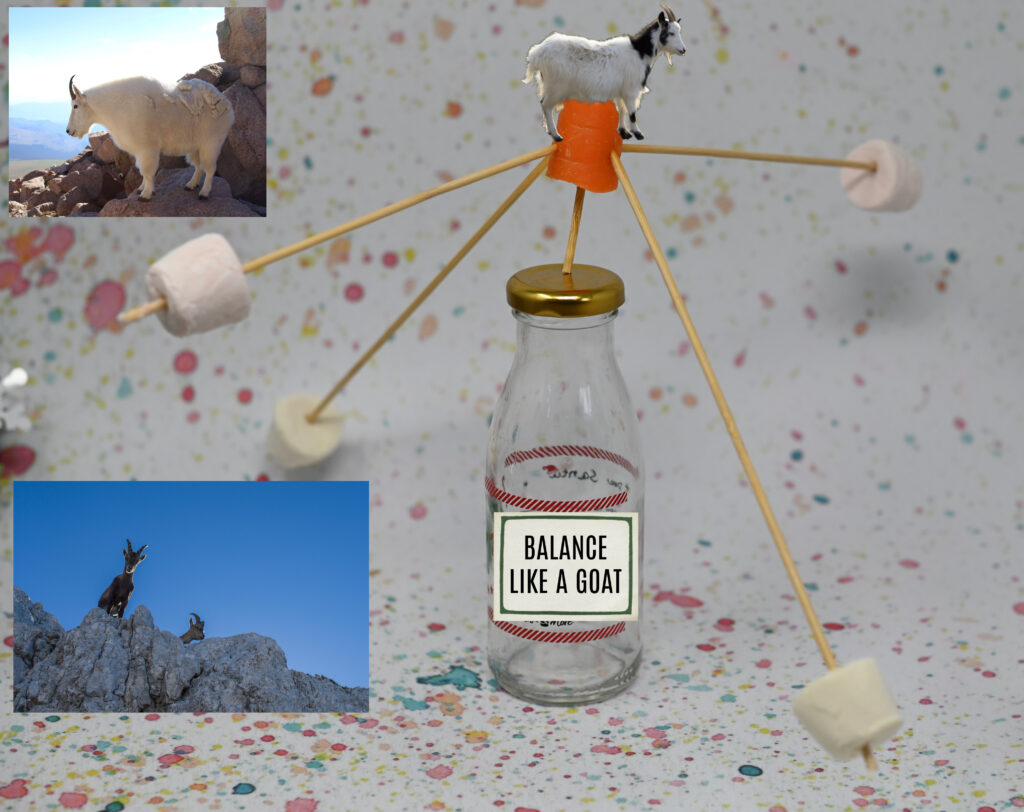
Cut a small piece of carrot and insert a wooden skewer approximately 2 inches long into the bottom. Most of the skewer should be outside the carrot.
Place the skewer on the top of the bottle, it will fall over.
Push the pointed end of two skewers into opposite sides of the carrot, and push a marshmallow onto the end of both.
Place the carrot onto the bottle lid. It should now balance!
Add two more marshmallow skewers to the carrot and see if it still balances.
Experiment by moving the marshmallows up and down the skewers.
Why does it work
The carrot ( goat ) stays balanced when its centre of mass is directly above the skewer. Gravity pulls downwards, and if the centre of mass isn’t lined up over the skewer at the bottom, it creates a turning force that tips the carrot over.
Adding skewers and play dough changes the centre of mass of the carrot. By adjusting the skewers and play dough bit by bit, you bring the centre of mass back over the bottle and the skewer at the bottom, keeping the carrot balanced.
Balance a Goat Template

Fun science facts about goats
- Goats have horizontal pupils, which allow them to see almost 320 degrees around them without moving their heads!! This is a fantastic adaptation for spotting predators.
- Goats are ruminants, which means they can eat shrubs and tough, dry grass. Their stomachs have four compartments, allowing them to regurgitate partially digested food to chew a second time.
- Cloven hooves allow each half to move independently, which is great for climbing.
- Goats can climb trees!
Year of the Monkey
Have you ever wondered how monkeys swing through trees so effortlessly? Monkeys are natural acrobats with exceptional dexterity, making them a great animal to learn about through a fun science activity.
Balancing Monkey STEM Challenge
This balancing monkey challenge is great for learning about Centre of Mass. For a monkey to balance on a tree branch, its Centre of Mass needs to be under the branch. Monkeys use their tails to help them balance in the trees. Adjusting the position of their tails helps monkeys shift their centre of mass, making it easier to balance as they swing through the trees.
You'll need
- Cardstock
- Scissors
- Template
- Paperclips or small coins
Instructions
Cut out the monkey shape from the template below (or draw your own) and try to balance it on your finger. The monkey will fall over.
Place 2 paperclips or a coin on the bottom of the arms and try again. The monkey should balance.
Add an extra paperclip and watch what happens.
Extension challenge: try other small objects instead of paperclips. A small coin or Play-Doh also works well.


Balancing Monkey Template

Fun Facts About Monkeys
- All monkeys have tails, although some are longer than others.
- Some monkeys have prehensile tails, these are strong tails which are used like an extra limb.
- Pygmy Marmosets ( finger monkeys ) are the world's smallest monkeys.
- The biggest monkeys are male mandrills.
- A monkey's tail is more than just a tool for balance. The tip of a monkey's prehensile tail has a friction pad with a unique pattern of ridges, similar to a human fingerprint. The ridges increase friction and surface area, which helps the monkeys grip small objects even when they are wet and slippery.
- Monkeys have large brains relative to their body size.
Year of the Rooster
Roosters are famous for the crowing noise they make in the morning! They have an excellent internal biological clock, which means they Cock-a-doodle-do at the same time every morning.
A rooster’s crow can reach 130 decibels, which is about as loud as a jet taking off! To prevent hearing damage, roosters have a clever built-in earplug. When they open their beak to crow a flap of soft tissue partially covers their eardrum to protect it!
This simple sound activity using a paper cup demonstrates how sound can be amplified.
Paper Cup Rooster
You’ll need
- Ribbon
- A plastic or paper cup
- Paperclip
- Water
- Thick tissue or a paper towel
- Pencil
Instructions
Thread the ribbon through the hole and tie a small knot at the end. The ribbon should be about 30 cm longer than the end of the cup.
Attach the paperclip to the ribbon so it rests on the bottom of the cup.
Wet a small paper towel.
Fold the paper towel around the ribbon and pull it down!
Why does it make a noise?
The cup acts like a soundboard. Try rubbing the paper towel down the ribbon without the cup attached. There's no noise. The cup amplifies the vibrations created by the movement of the paper towel down the ribbon, making a louder noise than you’d get without the cup.

Year of the Dog
A dog’s sense of smell is around 10,000 times better than a human’s! This simple activity tests your sense of smell as you hunt for scents around a room.
Hidden Smells
You'll need
4 paper cups
4 cotton wool balls
4 foods with a strong smell or flavoured essences, eg, vanilla extract, peppermint extract, garlic, ginger
Kitchen foil
Instructions
Place either a cotton wool ball with flavoured essence or a strong smelling food into each cup.
Hide the cups one at a time around a room and ask a friend to try to find them.
If it’s too easy, cover the cups with foil and try again.
Why does it work?
Things that smell give off tiny smell particles that float around the air. You smell these when they reach your nose! Dogs have superpowered smelling power partly because they have cold, wet noses that the smell particles can attach to more easily than a warm, dry nose!
Hidden Smells - Year of the Dog - Instructions

Fun facts about dogs
- Dogs are the most popular pet.
- Dogs evolved from a species of wolf that is now extinct. They were domesticated over 20,000 years ago!!
- They can be right or left pawed.
- Dogs have an amazing sense of smell.
- They cool down by panting.
Year of the Pig
Pigs are smart, have great long-term memories, can eat almost anything, and are surprisingly athletic thanks to lots of clever adaptations! In this activity, you’re going to learn about the incredible features of pigs that make them special.
Not just messy mud
Pigs roll in mud to cool themselves. Mud dries and holds onto the water, which then evaporates slowly, providing a long lasting cooling effect for the pig.
Super Snout Skills
Pigs have an excellent sense of smell that allows them to detect food buried in the ground!
Pig snouts are prehensile (they can move and feel), allowing them to move objects out of the way with their noses!
Warm Blubber
Pigs have a layer of subcutaneous fat that helps keep them warm because they don’t have much fur.
Marvellous Memory
Pigs have a good long-term memory. They can remember where food is hidden months later!
Big Lungs
Pigs have very large lungs for their body size, allowing them to move quickly for short periods of time.
Ultimate Eaters
Pigs can eat roots, fruit, grains, vegetables, dairy, and eggs. They are omnivorous foragers with a tough digestive system.
Cloven Hooves
Pigs have cloven hooves, meaning they have two toes split down the middle instead of a single solid hoof. When walking in soft mud, pigs can split their toes, which increases the surface area of their hooves, spreading the pig's weight over a larger area and helping it avoid sinking in wet mud.
Design a Super Powered Pig
Put your new pig knowledge to the test with this fun challenge to design a superpowered pig!


Year of the Rat
Rats are agile, social and smart animals with a great memory and amazing vibration sensing abilities.
In this activity, we're going to pretend to be rats and identify objects without using our eyes.
Rats rely more on their whiskers than their eyes and use them to identify the shape, texture and location of objects in the dark.
What is a whisker?
A whisker is more than just a hair. It grows from a follicle that is sealed by a capsule of blood, called a blood sinus. When a whisker touches something, it bends and pushes against the sinus, which triggers nerves that send a message to the brain. The rat uses information from its whiskers to identify and locate objects.
What is it? Objects in the dark challenge
The idea behind this activity is to use a pipe cleaner (a pretend whisker) to identify objects you can't see in a box.
Whiskers are so sensitive that they can detect very small changes in air currents and surface textures.
You'll need
- A sealed box with a hole in the side.
- Small objects with distinctive features, for example, a cup with a handle, a hairbrush
- A pipe cleaner or toothbrush
Instructions
Try to identify the different objects in the box using only a pipe cleaner or a toothbrush.
Rat Super Sleuth Worksheet

Fun Facts about Rats
- Rats can learn a route through a maze and remember it months later.
- A group of rats is called a mischief.
- Rats are mostly nocturnal.
- They use their long tails for balance.
- Rats' teeth never stop growing!
Year of the Ox
An Ox is a cow that has been trained to work, usually pulling heavy loads. Oxen are most often male and over 4 years old.
Like all cattle, Oxen have four separate compartments in their stomach that allow them to break down tough, fibrous grass for energy.
Rumen - like a huge storage tank where bacteria start to break down tough fibres.
Reticulum - filters out anything the animal shouldn’t have eaten.
Omasum - a series of folds that squeezes water out of the food.
Abomasum - acids and enzymes continue to break down the food, ready for the intestines.
Ruminant animals also regurgitate food. After its first trip into the rumen and reticulum, it’s regurgitated back up to the mouth to be chewed and swallowed again and again until it's small enough to digest!
Ox - Super Powered Digestion Activity
Model the Rumen
The rumen is like a huge tank where microbes break down tough plant fibres by a process called fermentation. Methane and carbon dioxide are produced during this process. We’ve used yeast to represent the microbes in the Ox’s stomach.
You’ll need
- A 500ml water bottle - empty - represents the Ox’s rumen
- 5g Yeast - represents the microbes in the rumen
- A balloon
- 2 tablespoons of sugar - represents plants
- Warm water
Instructions
Pour the yeast and sugar into the empty plastic bottle.
Fill the bottle about halfway with warm water, then quickly place the balloon on top.
You should see the balloon start to blow up.
The yeast in the bottle breaks down the sugar, releasing carbon dioxide, just as microbes in the rumen break down plant fibres.
As an extension task, you can try bicarbonate of soda instead of yeast!


Year of the Tiger
Tigers are the largest of the wild cats, they have 100 cm long tails, 7 cm teeth, and can be 4m long from nose to tail!. Tigers are strong, powerful predators who hunt alone. They have thick necks and strong jaws, making them exceptional hunters capable of killing animals much bigger than themselves.
Sadly, tigers have been overhunted for a long time, and their population has declined as humans have encroached on their habitat.
Each tiger has a unique stripe pattern, with orange fur and dark stripes.
Tiger Food Chains
Tigers are Apex Predators, which means they are at the top of the food chain. There are 6 subspecies of tiger, based on where they live and slightly different characteristics. The most common type of tiger is the Bengal Tiger, which makes up about half of all wild tigers.

Imagine what would happen if you removed the tigers from the chain. The population of primary consumers would increase, leading them to eat more plants and potentially destabilising the ecosystem.
Print the sheet below and cut out the images. Use them to create a food chain for tigers living in the glasslands and another for tigers living in the wetlands.

Year of the Rabbit
Rabbits are small, social mammals with long ears, soft fur, and fluffy tails. Domesticated rabbits are kept as pets, but rabbits are also found in the wild. Rabbits mostly eat grasses, but are also known for eating their own poo! This allows them to digest nutrients they didn’t digest the first time around! One rabbit can have 50 offspring in a single year!
Rabbits are also known for their distinctive hop. They can quickly jump through the air, thanks to their powerful hind legs and strong leg muscles.
The Rabbit Hop
Rabbits have very strong, long hind legs, which are the main reason they can jump so high and so far. They also have light, hollow bones, which allow them to jump with almost explosive power.
This activity shows how a rabbit’s hind leg is like a lever, allowing it to jump high without too much effort.
Rabbit lever legs
You’ll need
30 cm ruler
Table or solid surface
Small pom pom or light object
Instructions
Place the ruler on a table with about 5 cm hanging over the edge. Place a pom-pom on the edge farthest from the table, then push it down. The pom pom will fly into the air.
This time, move the ruler so that 10cm hangs off the edge. Measure how far the pom pom flies. The longer the lever (rabbit's leg ), the further the pom pom ( rabbit ) will jump!
The longer the lever arm, the further the pom pom flies. Levers make work easier. In this case, the longer the rabbit's foot, the easier it is to lift the rabbit off the ground.

Fun Rabbit Facts
- A baby rabbit is called a kit.
- Rabbits are very social and live in underground tunnels called warrens.
- Rabbits can turn their ears 180 degrees!
- A rabbit can give birth to up to 14 baby rabbits in one litter!
- A female rabbit is called a doe, and a male rabbit is called a buck!
Year of the Snake
Snakes are incredible hunters, amazing eaters, and great at disguising themselves! They are cold-blooded, scaly creatures found in most parts of the world. Snakes can unhinge their jaws, which allows them to swallow animals bigger than themselves whole!
The longest snake in the world is the reticulated python, which can exceed 6.25 metres! Reticulated pythons are found in Southeast Asia. They are non-venomous and can climb trees! In contrast, the smallest snake in the world is the Barbados threadsnake, which is a tiny 10cm long!
How long is a reticulated python?
This activity uses household objects (and hands and feet) to demonstrate the length of a reticulated python. It can also be adjusted for other snakes.
You’ll need
- 30 cm ruler
- Small object - building block
- Chalk
- Large area
Instructions
Measure the length of your building block or other small object in cm or inches if you prefer. Divide the length of a python, 625cm, by the length of the building block to work out how many blocks are the same size as a python.
Measure 625 cm on the ground and mark with chalk. Walk from the start to the end point and count how many of your feet long a reticulated python is.
Measure your height in cm and work out how many of you are the same length as a python.
Super Long Snakes Worksheet

Year of the Dragon
Dragons are fictional animals usually depicted as large, powerful dinosaurs or lizards with four legs, a long tail, and wings. They are famous for breathing fire and often live in the mountains.
If dragons were real animals, they would most likely be cold-blooded reptiles who hatch from eggs and sit at the top of the food chain!
For a dragon to have any hope of flying, it would need strong, but lightweight bones. Birds have hollow bones filled with air sacs connected to their respiratory system, which provides a constant supply of oxygen needed for energy, allowing them to fly!
This easy science activity demonstrates how strong a hollow tube can be!
Strong Hollow Bones
You'll need
- Paper
- Tape
- Books
- Paper plate
Instructions
Roll 4 paper tubes and secure with tape.
Place a paper plate on top of the tubes.
Add books to the top of the paper plate until the columns collapse.
Try this again, but with paper columns folded into triangles and squares.
You should find that the circle shaped columns can hold the most books without collapsing.
Engineering a Dragon Instruction Sheet

Complete Pack of 12 Science Activities for Chinese New Year

Last Updated on February 16, 2026 by Emma Vanstone


Leave a Reply