
We’ve talked about respiration before when we made bread and used yeast to make the dough rise. Blowing up a balloon with yeast is another very easy experiment to demonstrate respiration in action and is quicker than making bread if you are short of time.

What is respiration?
Respiration is a chemical reaction which occurs in animal and plant cells. It releases energy from glucose. Aerobic respiration needs oxygen, but anaerobic respiration doesn’t need oxygen.
Anaerobic respiration produces less energy than aerobic respiration. It occurs in humans when not enough oxygen reaches muscle cells ( for example, during hard exercise ). Bacteria and other microorganisms can also use anaerobic respiration, and yeast actually carry out an anaerobic process called fermentation.
Respiration occurs in the mitochondria of cells. You can find out more about mitochondria by making a model of a cell.
Blow up a balloon with yeast
A balloon
A small clear drinks bottle
A packet of dried yeast
Warm water
1 teaspoon of sugar
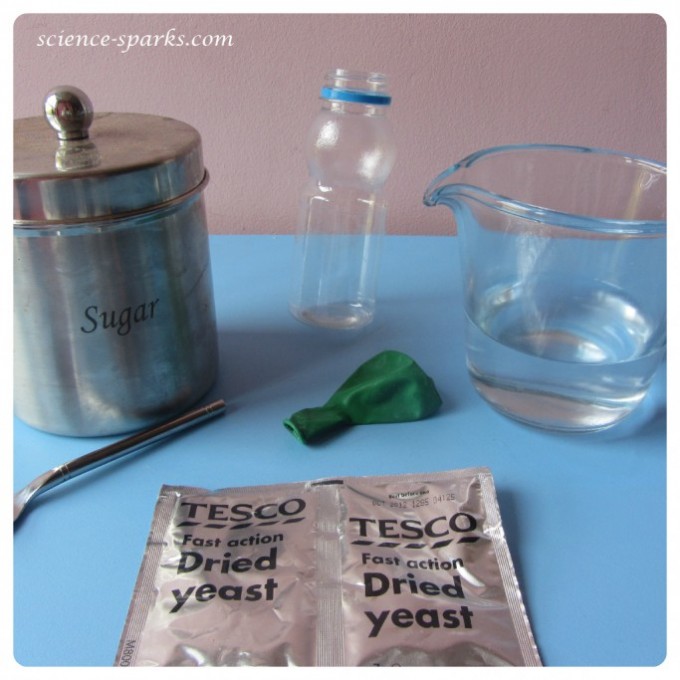
Instructions
1. Blow the balloon up a few times to give it some stretch. This just makes it easier for the experiment to work.
2. Fill the small bottle about 3cm full of warm water.
3. Add the yeast and 1 teaspoon of sugar.
4. Place the balloon over the open top so no air can escape.
5 Over the next half an hour, watch what happens. (Obviously, do other stuff and come back, it may be a little boring to actually watch it for half an hour!)
Yeast and Respiration
Yeast is a living organism. In order for it to survive, it needs to make energy. In its dried form, the yeast is dormant, but as soon as you provide it with warmth, water and sugar (its food), it ‘wakens’ and becomes active. The yeast uses the sugar (glucose) and oxygen from the bottle to make water, energy and carbon dioxide. Carbon dioxide is a gas, and this is what you see filling the balloon.
Remember, yeast can respire anaerobically when there’s not enough oxygen for aerobic respiration.
Fermentation
Glucose -> ethanol and carbon dioxide + energy
Aerobic Respiration Equation
Glucose + Oxygen –> Carbon Dioxide + Water + energy

The image is taken from Snackable Science which contains SEVENTY fun edible experiments and investigations!
Science concepts
Enzymes
Respiration
Contains affiliate links
Last Updated on May 3, 2023 by Emma Vanstone




Oooh I like this one a lot! I am storing them all up for rainy days but I’ll get to this one quite quickly!
What a cool project! Do the balloons float, then, like helium?
That’s so cool! We love everything science! My kids will love this!
Brilliant experiment!!!! The kids will love it!
Thanks for sharing on Kids Get Crafty!
Maggy & Alissa
all the experiments simple and kids could easily understand the concepts behind it.