
We love egg experiments here at Science Sparks. We’ve investigated air pressure using eggs, transformed egg whites, tested how strong an eggshell is, and even made eggs shrink. Today, however, we’re going to find out how to make an eggshell disappear. It sounds impossible, but it is actually very simple!
How to dissolve an eggshell
You will need the following:
An egg
A glass
White vinegar ( malt vinegar also works )
Instructions
1. Place the raw egg in a glass or small bowl.
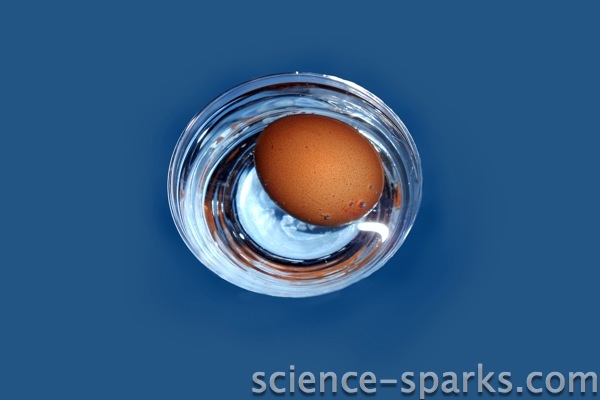
2. Cover the egg with white vinegar, making sure the whole egg is covered.
Q: What do you notice happening?
A: You should see bubbles collect around the shell (a sign that a chemical reaction is taking place)
3. Leave for 24 hours.
4. Rinse the egg and place it back in the vinegar if any shell still remains.
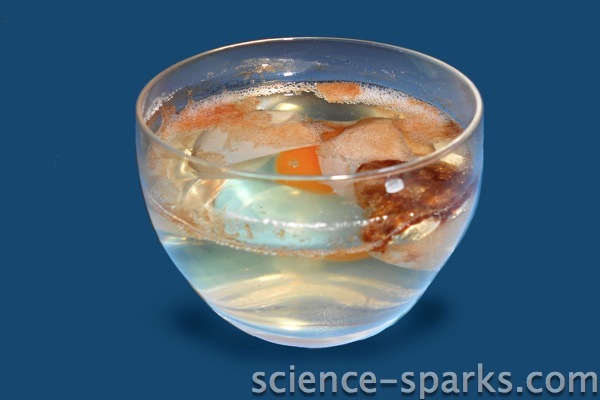
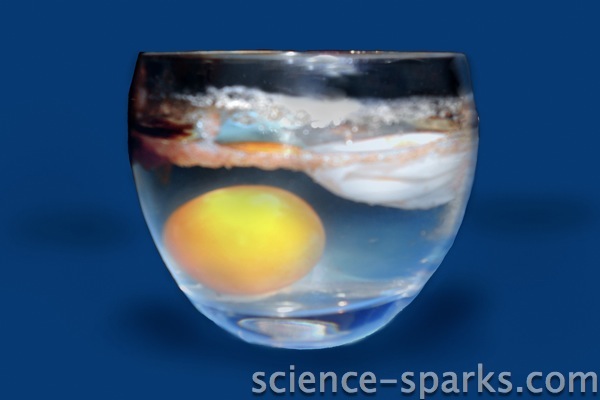
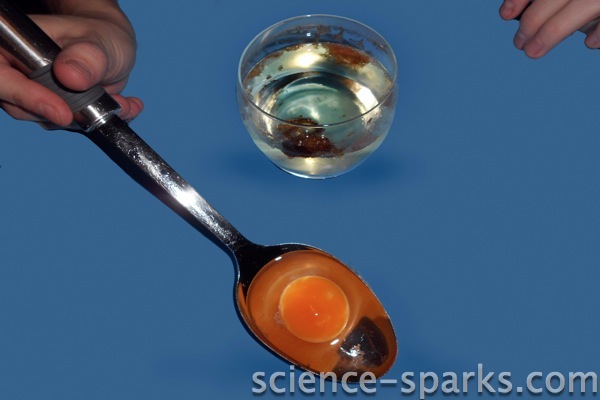
You should now be able to see eggshell residue in the vinegar and the yolk whole in the egg white. If you still see white residue on the egg, you can rub this off lightly with your finger. I tried to lift the whole egg out of the vinegar but broke the membrane. However, it is possible to lift it out whole.

Make an eggshell disappear – what happens?
Eggshell is made up of calcium carbonate, which is dissolved by acids ( in this case, vinegar ). The inside of the egg remains intact because the vinegar doesn’t break down the egg membrane.
The egg will also swell up because some of the liquid seeps inside it via osmosis. You should be able to see the yellow yolk through the membrane. It really is quite incredible.
You can use the same method to make a bouncy egg.

Last Updated on June 7, 2023 by Emma Vanstone
wow I never knew that could happen, will be trying this at home.
Great! Let me know if you manage to keep the egg whole. 🙂
If you leave the egg for 48 hours then the shell is gone but the membrane is still entacted. The egg can be taken out & even bounces a little-not too much because it will break. My 4yr old daughter loved it.
This is so cool! My kids will love this!
It is so easy and effective, but put is somewhere that you don’t mind the vinegar smell!
Very cool! you are my science star, i truely learn a lot from you!
Oh I love being called a star! Thank you very much. Glad you like it!
This is too cool!
Its fab isn’t it?
This is a great experiment! Beautifully photographed, too =)
Thanks you, I had some assistance this time.
Just hopped over from Kid’s Get Crafty Link up – Wow – What a great experiment. Thanks for sharing.
Ellie
thank you!
Well I never! So what does Vinegar do to our stomachs.. eeek!
Thanks for sharing on Kids Get Crafty!
Maggy
Luckily we have not got any calcium carbonate to react with and it contain hydrochloric acid in it anyway to digest food, so it is used to acids. x
this is SO cool! I’m going to share this with my blog’s FB followers. Thanks (as always) for sharing the coolest experiments!
This is a fun and simple experiment! I am going to do it here (while husband is away and doesn’t mind the egg floating around for 5 days). And now I am following your terrific site in Google reader.
thank you x
Cool and interesting. I love how smart you are! Thanks for sharing at Monday Madness. Hope to see you again tomorrow!
Thanks! Did this with my 5 & 3 year old. They loved to watch the shell dissolve, then handle the squishy egg. We extended the experiment, next soaking the egg in corn syrup (to draw out the water), then water tinted blue (which made the egg expand), then salt water (floating & dessicating). Finally broke it open to find a green yolk. We are starting it again this week — got to figure out what our soaking liquids will be.
I’ve tried this with boiled eggs before so the children can touch it to feel the difference. I’ll have to try a raw one too.
Just to make sure…can we still cook and eat the result? (Maybe not, but I wanted to ask.)
Thanks!
The membrane should have protected the inside of the egg 🙂 Not sure of the best way to cool it though!
If you don’t want to smell the vinegar put the egg and vinegar in a Ziplock baggie. Then put the baggie in a clear glass. This way you can still see what is happening without the intense smell! 🙂
What a good idea!
We did this with two eggs, one in colored vinegar and one in plain vinegar. We just covered each cup with plastic wrap and it didn’t smell at all. When we were done marveling over the results and playing with the eggs we took the colored one outside and exploded it so we could see how the white had actually absorbed all the color and our yolk was still nice and yellow. Excellent experiment!
We’ve tried it, left for 5 days, the shell dissolved but the membrane stayed. How do you make it dissolve too? When we cut the membrane, the egg white was very liquid (like water) and the yolk became like slightly boiled.
the membrane is meant to stay on, our just broke! xx
I loved this one! GGtook it into her class last year. It took nearly two weeks and absolutely reeked, but the kids were fascinated and GG was the coolest girl on the play ground! Glad it was Kerry’s x
That looks very cool and an experiment I don’t think I could mess up!
Thanks for this, tried this with my son and he loved trying this out.
My daughter did this several years ago. We soaked the egg in vinegar for over a week. The egg membrane did not break when taken out of the vinegar. In fact, we could lightly bounce it on the table.
The reverse osmosis would be to take that naked vinegar soaked egg and submerge it in corn syrup for a couple of days. The end result will be an empty egg because all the liquid is pulled out of it. You can repeat this process over and over. Really is pretty neat.
I will add that she did this for a science fair project. She won 1st place in her school and 2nd place in the whole county.
=-))
this is such GOOD experiment to prank your friends with
But why doesn’t it also ‘Eat’ away the membrane?
That is such a great idea for a prank. LOL!
Yo mama so fat, her belly button got home 15 minutes before she did!