
Density can be a tricky concept to grasp. Density refers to how much mass there is in a particular space. Imagine a drawer full of socks. It has a specific density. Suppose you take a sock out, the density of the drawer changes. This is because the mass of the socks has changed, but the volume of the drawer has stayed the same.
Generally, the greater the density of an object, the heavier it feels.
Solid substances are denser than their liquid and gas counterparts as the particles in a solid are much more closely packed together.
What is Density?
The density of an object is found by dividing the mass of the object by its volume.
Density Formula
Density = Mass divided by volume
The units used vary depending on the units of mass and volume used for the calculation.
If the mass is measured in kg and volume in cm³, the units for density would be in kg/cm³.
Something else that can be confusing is mass. People often talk about weight when they mean mass and vice versa.
What is mass?
Mass is a measure of how much matter an object is made up of. The mass of an object remains constant unless you add to or remove part of it.
The weight of an object depends on gravity. Your weight would be less on the moon as there is less gravity, but your mass would stay the same.
You can do lots of very cool demonstrations to demonstrate density in a fun, hands-on way.
Easy Density Demonstrations for Kids
These easy density demonstrations are super simple and brilliant fun ways to show kids ( and grown-ups) this tricky concept in action. There are also a couple of nifty tricks too!
How to make a Density Jar
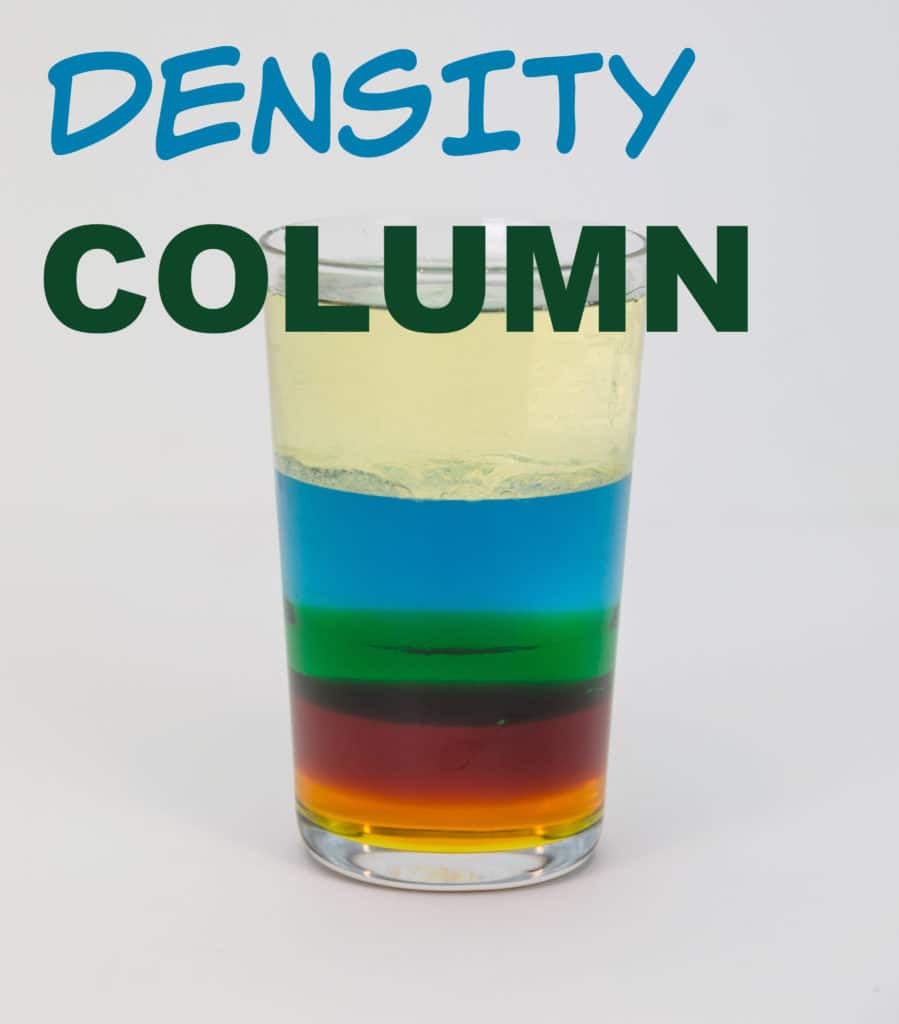
Image taken from This IS Rocket Science
What you need to make a density column
Vegetable or sunflower oil
Water
Food Colouring
Washing up liquid
Honey
Golden Syrup
LEGO or other small objects.
How to make a density column
First, make a very simple version using just oil and water.
- Pour some water carefully into a glass or jar.
- Very carefully add about the same volume of cooking oil on top.
- Carefully drop a couple of small objects into the mixture and observe what happens. Can you find an object to float on each layer?
What happens if you shake the jar? You should find that the oil and water mix up and then separate again.
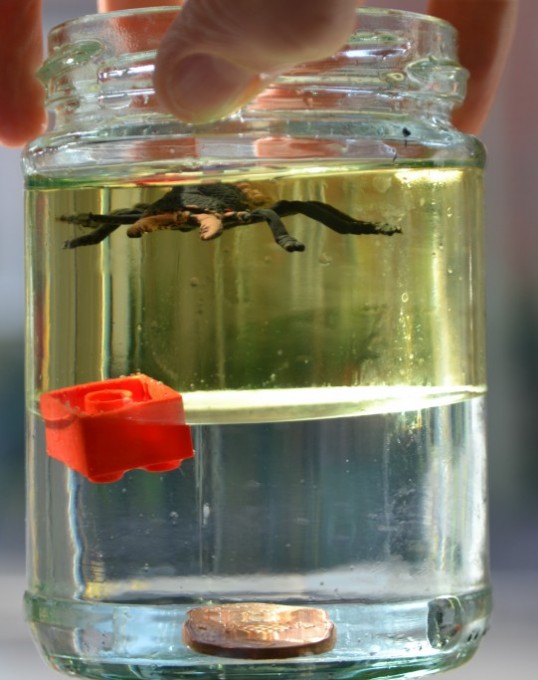
To make a density column with more layers like the one above, you need lots of different liquids of different densities.
We used honey, golden syrup ( or corn syrup ), washing up liquid ( dish soap ), water and food colouring, and vegetable oil, in that order.

Density of Liquids
Each of the liquids has a different mass of molecules or different numbers of parts squashed into the same volume of liquid; this makes them have different densities. Therefore, one can sit on top of the other – the more dense a liquid is the heavier it is.
Objects and liquids float on liquids of a higher density and sink through liquids of lower density. The LEGO brick falls through the oil but floats on the water, while the coin sinks through both. The coin is therefore more dense than both the oil and the water. The plastic bug floating on the oil is less dense than both.
More Density Experiments
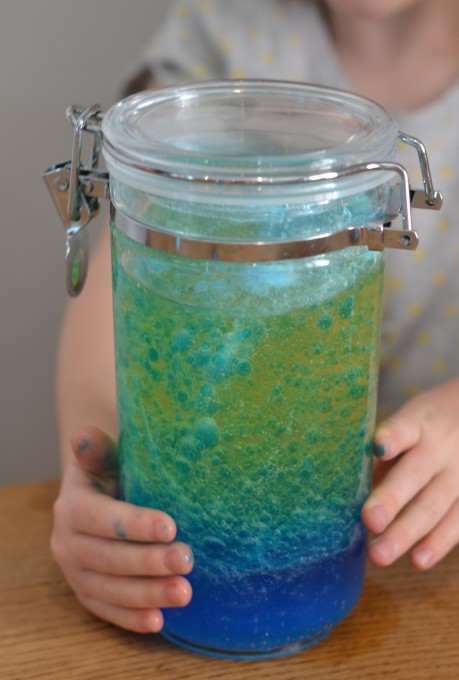
Homemade Lava Lamp
Homemade Lava lamps are a fun activity demonstrating that oil and water don’t mix.
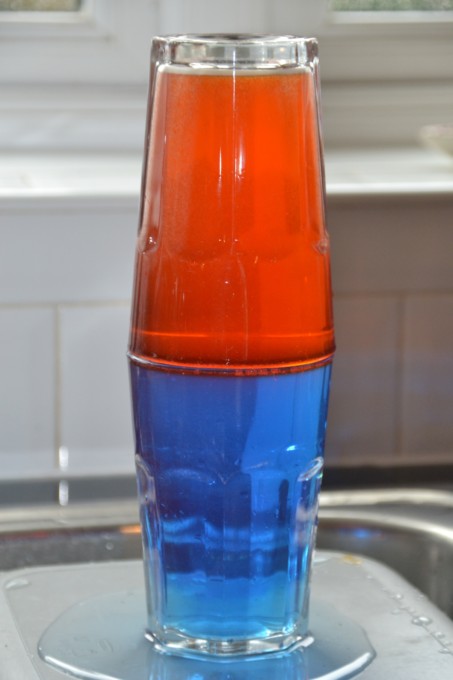
Density Trick using Salt and Water
Show your friends a science magic trick and a fantastic density demonstration. This activity uses salt to change the density of one colour of the water.
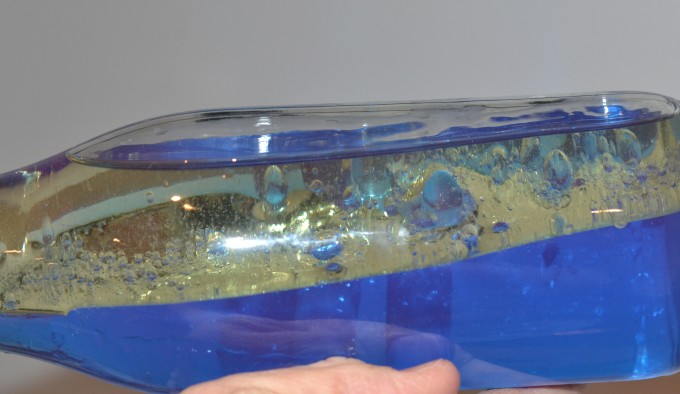
We also have a pirate themed density bottle. Pirate treasure is perfect for hiding in the layers.
Density and Floating Activities
Did you know that if you reduce the density of an object that sinks in water, it will float? We tried this with a heavy ball and used bubble wrap to make it less dense. The addition of the bubble wrap made the ball float!
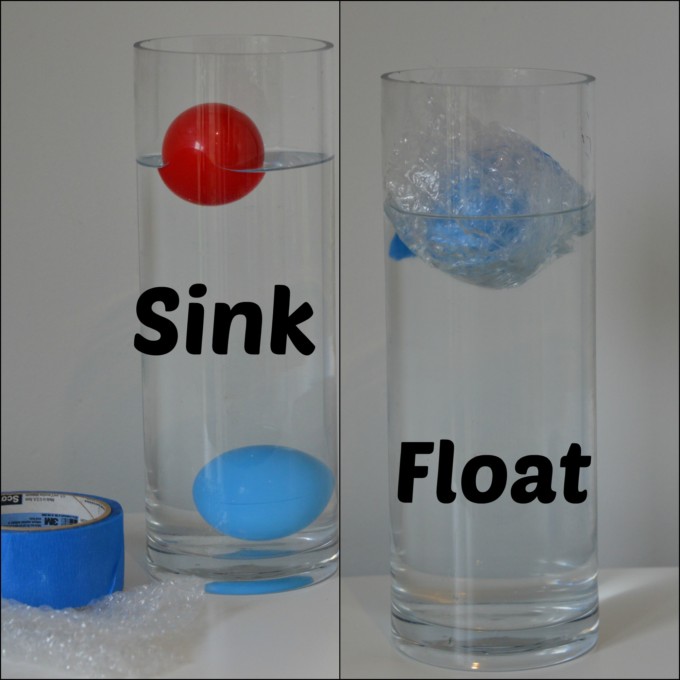
You can also use the same logic to make a lemon sink or an egg float!

Science Concepts
- Density
- Mass
- Volume
- Sinking
- Floating
More Awesome Science Experiments for Kids
Don’t forget we have 100s more fun and exciting science experiments for kids on Science Sparks.
Some of my favourites are our Fairy Tale Activities, where you can make a raft for the Billy Goats and a Zip Line for Jack and the Beanstalk. The infamous coke and mento explosion is always great fun to watch, and our water science experiments will keep you busy for weeks!
Wherever your interests lie, you’re sure to find something you like in our vast collection of science experiments and investigations.
Science Books from Science Sparks
I also have a couple of science books available you might like!
This IS Rocket Science
This Is Rocket Science includes 70 fun experiments for kids (and adults ) showing you how to use everyday items like bottles, cardboard, glue and tape to build excellent rocket ships, paper spinners and mobile rocket launch pads, all while learning about the scientific concepts behind space travel.

Snackable Science
Snackable Science contains 60 edible experiments allowing kids to investigate their way around the kitchen, making magical mixtures, edible Jenga and Tetris, finding the perfect ketchup, and even creating their own super sour candy powder. It’s colourful, inviting and just brilliant fun.

Last Updated on January 29, 2024 by Emma Vanstone
Oooooh! So that was it! *hunts for rainbow glass tutorial!*
Fun! We need to do this – I think my kids would love it!
Fabulous. I love the easy way you’ve explained it. Pinning to my science board 🙂
Thank you. x
I have treasures that would be great for this lesson.
do let us know if you do it. x
Fantastic. Such a fascinating science experiment for kids!!! Love it.
PS thanks for sharing on Kids Get Crafty!
So cool!! I love it. Thank you for sharing on Sharing Saturday!!
Another great demo for teaching density would be with pop. What you need is a fish tank full of water, a diet coke, and a regular coke. When you put the two cans in the water, the diet coke will float and the regular coke will sink. Explain to the kids that since the diet coke does not have as much mass, it is less dense so it floats.
Experiments like these are prefect for making learning fun for kids. It can spark their enthusiasm towards science. Thanks for sharing this idea!