
Plants don’t always seem like the most interesting of topics to study, but there are lots of brilliant, hands-on plant science experiments and activities which are fantastic for learning about different types of flowers, trees and plants and the conditions they need to grow.
I also have a free booklet at the bottom of the post containing information and plant activities suitable for Key Stage 1 children ( that’s ages 4-7 for anyone not in the UK ).
Plant Science Experiments for Kids
What is a wild plant?
A wild plant seed grows wherever it falls without being cared for. Examples of wild plants include dandelions, daisies, buttercups, nettles and ivy.
Try a treasure hunt to see how many wild flowers children can find, they could even press them and then stick onto a collage.
What do plants need to grow?
Find out what happens when a plant is short of water in this easy activity.
Try growing a bean in a bag, a CD case or a jar. Observe the changes daily and keep a record.
Grow seeds in test tubes which will allow the growth and roots to be seen clearly.
What is photosynthesis?
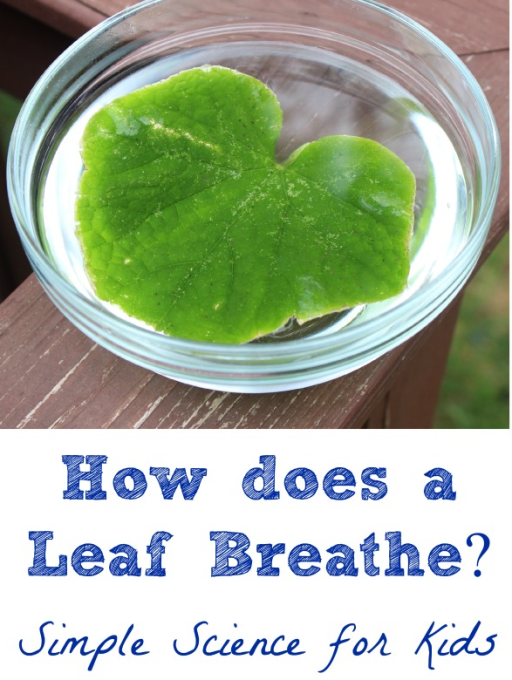
This is more for Key Stage 2 or 3 but interesting for little ones all the same. Observe the gas released during photosynthesis in this brilliant activity from KC Adventures. Do you think you’d still see the gas bubbles if the leaf was kept in the dark?
Plant structure and transport
Try a simple capillary action experiment and discover how plants transport water up their stem against gravity!
Dissect a bean like Buggy and Buddy.
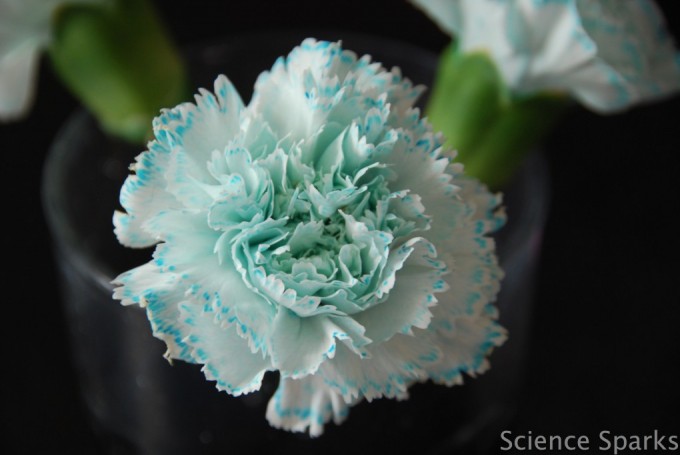
Discover how a plant transports water from it’s roots to petals in this colourful experiment.
Grow a bulb in a glass jar and observe the root growth.
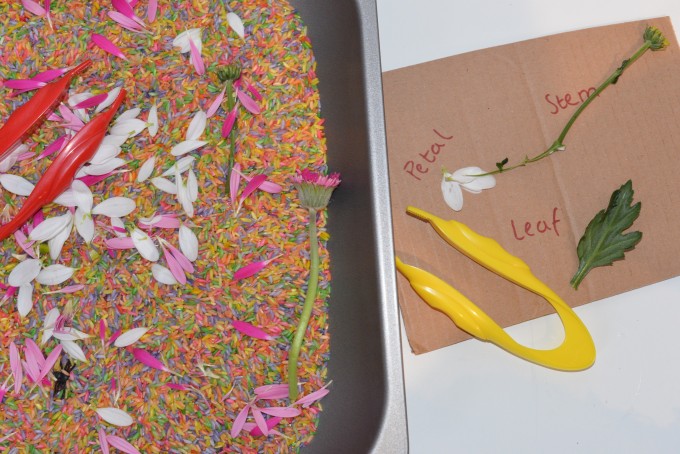
Set up a flower sensory tray and pick up the parts of the flower using tweezers.
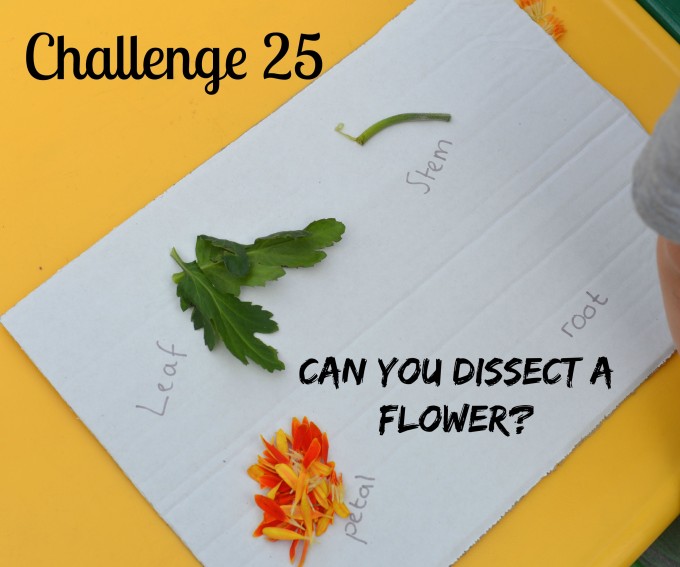
Dissect a flower to learn about the different parts.
Set up a fine motor sensory tray and ask children to use tweezers to remove the different parts of a flower.
Find out what happens when a plant doesn’t get enough sunlight and make a fun cress caterpillar at the same time.
Did you know that some vegetables can be eaten and then regrown? Investigate the conditions needed to help each grow successfully.
Find out how pinecones protect their seeds by making a pinecone weather station.
Plant cells are a way beyond Key Stage 1, but we modelled ours on a pizza. Can you guess which part is represents the choroplasts ( the organelle where photosynthesis occurs ) ?

Key Stage 1 Plant Science
Plants
Identify and describe the basic structure of a variety of common flowering plants, including trees.
Observe and describe how seeds and bulbs grow into mature plants
Find out and describe how plants need water, light and a suitable temperature to grow and stay healthy
Key Stage 2 Plant Science
Identify and describe the functions of different parts of flowering plants
Plant Science Resources – Key Stage 1


Last Updated on May 7, 2024 by Emma Vanstone



The idea of modeling plant cells on a pizza is an absolute brainwave! I’m a STEM blogger and have written up a collection of science activities with plants just like this one: https://kidpillar.com/best-plant-science-activities-kids/